Monday, July 19, 2010

Taekwondo

The national sport of South Korea is Taekwondo, which is characterized by its fast, high and spinning kicks. Most boys take Taekwondo with their other academy lessons, especially the younger kids. And since Taekwondo is uniquely Korean and I’ve had some exposure to it, I thought I’d blog about it.

Martial arts have been practiced in Korea for about a zillion years, but was originally called Teakkyon and Subak. Let’s fast-forward past the hard-to-pronounce dynasties and examine the modern history of this sport. When Japan was doing its thing here in Korea, Koreans studied Karate and Judo (from Japan) as well as Kung fu (from China) because remember, Korean culture was illegal, including Korean martial arts. After the occupation ended in 1945, martial arts schools, called kwans, opened throughout the country.

At the height of the Korean War, martial art exhibits caught the eye of the President who told a dude named Choi Hong Hi to teach this to the Korean army. He named the sport Taekwondo and the kwans supported him by forming the Korea Taekwondo Association (KTA) to unify a standard practice.

It’s estimated that 70 million people in 190 countries practice Taekwondo. It’s one of only two Asian martial arts that are included in the Olympic games (the other is Judo.) It started as a demonstration event when the games came to Seoul in 1988, and became an official medal event with the 2000 games in Sydney, Australia.

Taekwondo differs from other practices because it emphasizes kicking. There are throwing arts, like Judo and Hapkido (another martial art from Korea.) The Brazilian Jiu-Jitsu is a form of grappling and Muay Thai (from Thailand) is in the striking category. There are also weaponry focuses like fencing and numchucks.

People who practice Taekwondo consider it a way of life and students are encouraged to live according to the 5 tenets:

  1. Courtesy: To be polite, thoughtful and considerate of others.
  2. Integrity: To be honest and good. Practitioners should live by a code of moral values and principles.
  3. Perseverance: To never give up in the pursuit of one’s goals. Challenges are welcome because they force us to grow and improve..
  4. Self-Control: To have control of your body and mind, actions and reactions.
  5. Indomitable Spirit: To have courage in the face of adversity. A Taekwondo student should never be dominated by, or have his spirit broken by another.

Everyone starts out with a white belt, representing innocence, it’s part of the uniform called a Dobok. The next belt is yellow. There are two tests between belt colors, passing the first test gives a stripe, the second is the full color. The yellow belt represents the earth and the rising sun.

The next color is green and is compared to a plant growing its leaves, starting to get power.

Blue is next. It represents the sky or heaven and strength in skills, like a tall plant growing to the sky. Physical and mental power start to stabilize here.

The following belt is red, for danger. It’s the color of blood, the essential life force. Maturity, honor and respect are exhibited and skills are perfected. The student is warned to practice control of his/her movements and also cautions any opponents.

And we all know the black belt is the final level, which represents maturity and rejecting darkness and fear. It is also the combination of all color. This is the final stage where technique is mastered.

Like I said, Taekwondo is known for its emphasis on kicking. The rationale is that the leg is the longest and strongest weapon a martial artist has, so kicks have the greatest power. It should also be noted that, historically, Koreans thought that hands were too valuable to be used in combat.

Taekwondo is popular with both genders and has a wide age range of participants. I often see senior citizens coming in and out of the local kwans on my morning walks. Physically, it develops strength, speed, balance, flexibility and stamina.

Another aspect of Taekwondo is Kyepka, more commonly called the break test. It’s a mandatory part of the black-belt exam and is popular in demonstrations. It’s believed that breaking an object is a good way to practice concentration, power, and precision on non-living objects. It’s used to learn the body is a very strong weapon and reinforce self-restraint when fighting another person. Breaking can be performed with any rigid part of the body. The most common are the hand or foot, but it can also be done with an elbow, knee or head.

There are two common classifications of breaks: speed and power. Speed breaks are breaks where the object isn’t held in place. The only way to break the object is to hit it with enough speed. Sometimes the board is held lightly between two fingers, sometimes it is dropped and must be broken while it falls. No matter how much power is used, the board will not break unless it is hit fast enough.

Power breaks are supported, either by a person or a structure. It is common for black belts to test with bricks, concrete or several boards.

The practice of breaking is controversial because a lot of times the material used is doctored in some way, giving the impression the performers are more powerful than they really are. In competitions, materials are inspected beforehand.
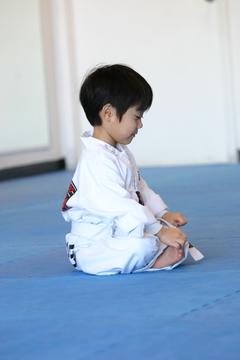
Another important aspect of Taekwondo is meditation. The goal is to be aware of everything and distracted by nothing.

Taekwondo stresses harmony with nature. It’s not just a physical expression, but a mental and spiritual conditioning as well. There is an entire philosophy to it. For instance:

  • If you know your opponent and know yourself, then you will always win.
  • If you do not know your opponent, but know yourself, you will win half the time.
  • If you know neither your opponent nor yourself, you will always lose.
  • Tactics don’t survive without strategy.
  • With confidence there is no fear, without it, there is no hope.
  • Success is only possible through desire, determination, drive, dedication and discipline.

I’m not sure if it writing an essay is mandatory to progress to a black belt, but as I’ve been researching this topic online, I’ve come across many essays. This is an essay written by Mike D’Agostino in December of 2005.

Tae Kwon Do - First Degree Black Belt Essay

When I first decided to get involved in tae kwon do I did so for the physical training. I hadn’t played an organized sport in over four years and daily workouts at the gym became boring and uninteresting. I needed a different way to incorporate a daily workout that is important to me to keep up a healthy lifestyle. Tae kwon do became a refreshing change.


The classes in the beginning were physically intense. I got headaches often from thinking about the classes all day and having a tough physical workout looming over me throughout the day. There definitely were times I hesitated coming to class because I knew it would be a tough workout. I think that at the time I didn’t know, or better yet understand, that it wasn’t the physical workout I was dreading, it was more the mental workout. It wasn’t that my body wasn’t prepared for the class or that I couldn’t do all the sit-ups or push-ups, it was the fact that I wasn’t sure if I was mentally prepared. The only thing I had to go by was that no matter how unwilling and lazy I felt, as soon as the class was over I felt so much better, so relieved and satisfied that I forced myself to come to class and that if I finished the workout, that I would completely forget about not wanting to go.


This went on for almost a year. Feeling apprehensive about going, taking the class, and then the feeling of satisfaction. I guess at around yellow or purple belt I made up in my mind that I was sticking with tae kwon do and that I was in it for the long haul. Slowly over the next year my attitude changed from having to force myself to go to class to wanting and needing to go to class. It was at this point the mental training tae kwon do offers started to take over the physical training.


I think blue belt was probably the biggest jump for me. Getting to blue belt signified a jump in training. I was no longer a “low-belt” and more exercises, or a more intense workout was required and expected, not just from Master Vince, but from myself. I wanted to be able to do all the exercises, I wanted to perform all the more difficult techniques. Like I said before, this required more than just a strong body, it required a strong mind.


I believe now that the mental training of tae kwon do far outweighs the physical training. The physical training has to stop at some point in the long run, but the mental training lasts a lifetime. I am able to perform in class and do all the exercises and all the techniques because I believe that I can. I believe that tae kwon do is a mental exercise. It requires focus and concentration and a willingness to believe that you can do whatever it is you want to do. Getting to black-belt is a symbol that I have the ability to put my mind to anything to accomplish my goals. Tae kwon do has helped me get to this point using little steps. When I first started out it was believing that I could do 30 sit-ups, then it got to 40, then 50…I think now we’re up to about 100. But it’s the ability to believe that I can do it that sharpens my mind and gives me confidence that I can do whatever I want to do.


The results speak for themselves. Almost four years ago when I started I had stopped going to school, didn’t have a job and had a hard time feeling comfortable in social situations. Fast-forward to today and I’ve graduated college, have a good job doing what I want to do, and actually enjoy myself in social settings. I can honestly say that I wouldn’t feel as comfortable with myself and the direction my life is going without tae kwon do.


I hope to pass on everything I’ve learned to other people at the school. I’ve gone through everything they are going through and hopefully by looking at me and what I’ve accomplished, through dedication and hard work, it will inspire them to keep training and push forward. I hope to start helping out teaching some of the classes. In the few classes I have managed to teach, even if just doing the warm-ups, I’ve learned a lot about how different people react to various forms of teaching techniques. And by figuring out how to inspire people and get them to train as hard as they can, I’m learning at the same time.


Tae kwon do has inspired me to become a better person and has given me the discipline and confidence to accomplish any of my goals. The impact from my tae kwon do training has only been positive.

Thursday, June 24, 2010

Follow up on Tim (and Matthew)

The blog I’ve received the most responses from was ‘A Boy Named Tim,’ so I thought I should follow-up with that whole situation and how it’s progressed.

When I wrote that blog back in December, I had only taught Tim a few times. I’d been teaching Matthew, his older brother, since I started at Sky, and definitely found him to be... a challenge. I like Matthew, but he is constantly disruptive and distracting.

There are times when I have to reprimand a student, and then when we get back to the lesson and he/she reads the passage perfectly. Obviously my affirmations need to be just as swift as any punishment. This has been an invaluable lesson for me – I can’t hold grudges and create a welcoming learning environment, it’s as simple as that. But this is something that takes a bit of maturity to practice, so it’s not surprising a few of my students still resent Matthew’s (and Tim’s) disruptive behavior.

In a way, I think the practice of chastising a student for poor behavior is a very Korean thing to do. When I speak to those who’ve travelled to Asia, or know someone who has, I constantly hear how ‘rude’ the people are. Instances of ‘cutting in line’ and being pushy are remembered vividly, which are totally valid and accurate. But the longer I’ve been here, the easier it is to see how essential these practices are.

The sheer number of people in this content requires an assertive attitude, otherwise no one would get anywhere. I think this is true for the public ridicule I’ve witness in regards to troublesome students. Classmates of the same age find poor manners deplorable. But regardless, it’s always a little shocking to me when classmates shun another student. It’s a really foreign act.

Anyway, back on topic. Tim and Matthew. So Tim and I originally had private lessons, and he’s a bright kid who is quick to laugh. He’s also the only student I’ve taught who is ambidextrous, which is impressive. Then our class size tripled and now he shares the spotlight with Brian and Jenny. But he’s not the best at sharing. He’ll act out and deliberately misbehave so I'm forced to give him more attention. And at first I did.

I imagined what would happen if I told his mother of his actions, and opted to tackle this challenge alone, but he was taking away attention from other students. So now I give him a choice: he can misbehave on the other side of the room or he can join us. It’s been pretty successful too. He’s learned that if he wants to screw around, I’m not going to give him attention, and his classmates won’t want him on their team, or, he can behave and join in the fun.

Whenever a class finishes a book we celebrate with a pizza party, so, as promised, when Matthew’s class finished ‘Side by Side 3’ I bought a pizza. Only Matthew came to class that day, so it was just us, a barbeque pizza, a deck of cards and Moby. He really liked Moby. Then out of the blue, we had this conversation:

Matthew: My father scare sometimes.

Now, I didn’t know if that meant his father was scared, or is scary, so I just kept quiet and waited for him to clarify.

Matthew: He mad a lot.

Me: I get scared when my father is mad.

Matthew: Your father hit you?

Me: No. He never hits me.

Matthew: Sometime my father hit.

Again, I had no idea what to say. I’d imagine I’d have a clearer set of instructions of what actions to take if I taught in the states, but not here. There are no actions. The concept of child protection does not exist.

Me: Why does your father get so angry?

Matthew: He work at prison and is stress.

Me: Yeah, that sounds stressful.

Matthew: He hit mother.

Me: And then your mother hits you?

Matthew: Yeah.

Me: I think I would feel angry and scared if my mother and father hit me.

Matthew: Yeah.

Me: I won’t ever hit you.

Matthew: I know teacher.

And as quickly as the conversation started, it ended. He commented on how much he loves pizza, to which I agreed, and asked if he could give the leftovers to his mom. It was a heart wrenching conversation, and I still feel like I wasn’t adequately supportive. It’s hard to know what the hell the say in a situation like that.

Even though having class with Tim and Matthew can be taxing, it’s been a really rewarding experience also. They’re bound to have behavioral issues, but it makes their sincere moments that much better. So, yeah, they are definitely a challenge, probably my most challenging students, but they are also some of my favorite students too. Tim always pops his head in my classroom when he leaves and says, ‘see you rater teacher,’ and Matthew is always so tender with me. He gently cups my face when he asks a question, or pats my back when he walks past, so, I’m happy to take the good with the bad.

Wednesday, June 23, 2010

The ABC's of Hangul

If you ask a Korean to name something uniquely Korean, they will likely say kimchee, the spicy national dish of fermented cabbage. Or maybe Taekwondo, a branch of martial arts from Korea. Or maybe some sort of technological development, which are all true, but not what this blog is about. Today you will read about the Korean alphabet known as Hangul.

The Korean language is thousands of years old. Linguists say that it belongs to the same language family as Mongolian, Hungarian, Turkish and Finnish. When I read that I was flabbergasted, I mean, what does Korean and Finnish have in common right? None of those languages (besides Mongolian) even come from the same continent!

From the fifth century, Korean was written in Chinese characters. There were a few ways to write it, but they were all quiet complicated, and in order to read and write, you had to learn thousands of intricate characters. This meant on scholars could master it.

King Sejong the Great is the father of the modern alphabet. Sejong became king in 1418, and ruled during a period of great economic, cultural and political development in Korea. The era was known as the Golden Age. The Golden Age? I know, right? My exposure to history is so skewed to Western Civilization, when I first read Golden Age I thought that can’t be possible, first of all, that took place in Italy about 40 years later. But alas, I can freely admit that when it comes to Eastern history (and most parts of Western history too I dare say) I am completely ignorant.

Anyway, this king, King Sejong, was quite the Renaissance man himself. He was a swordsman, an astronomer, a poet, a musician and a scholar. He founded the Chiph-yon-jon, a royal academy of scholars. This institute published books on history, geography, agriculture and medicine.

Clearly he was an enlightened ruler, and part of his vision included a national plan to have all Koreans become literate. He believed using Chinese characters to express Korean ideas was like trying to fit a square tool into a round hole. Along with the academy, he began a ten-year project to design an easily learnable alphabet. When the work was completed, King Sejong published a proclamation called Hun-Min-Jeong-Eum (‘Correct Sounds to Instruct the People’). In this document he wrote:

‘Because Chinese characters are a foreign writing system, they cannot truly capture Korean meaning. Common people have no way to express their thoughts and feelings. Therefore, we have created a set of twenty-eight letters. The letters are easy to learn and it is our hope that they will improve the lives of the people.’

The new alphabet became known as Hangul, meaning great letters.

Unlike Chinese, Hangul is a phonetic language: each sign represents a sound. And unlike English, where each letter may have several sounds, the pronunciation of the Korean letters is constant. Originally Hangul had twenty-eight letters, but only twenty-four are used today. There are three basic vowels, shaped like the three most important elements in Taoist thought: sky, earth and humanity. The symbol for the sky is a dot, the symbol for earth a horizontal line, and the symbol for humanity is a vertical line. The other vowels are created by adding strokes to these basic symbols.

The shape of the five basic consonants is based on the shape of the mouth and tongue when the sound is pronounced. Other consonants are variations of these five consonants. Letters are grouped into ‘syllable blocks.’ Each syllable block has a max of four letters and begins with a consonant. Each consonant is followed by one or two vowels. Hangul can be written in vertical columns from top to bottom and right to left, or in horizontal rows running from left to rignt.

Just because King Sejong create an easily learnable alphabet doesn’t mean it was immediately accepted. Scholars who had spent a lifetime learning Chinese characters opposed the new alphabet most. They referred to Hangul as ‘morning letters’ because the alphabet could be learned in a sing morning. Sometimes they called it ‘women letters’ because, at that time, only men could be scholars. For centuries, Hangul was mainly used by people of lower social status. It wasn’t until after WW II that it was more and more popular in South Korea. And in 1949, North Korea outlawed the use of Chinese letters altogether.

The invention of this language has created some remarkable results. Korean children learn to write at an early age, and illiteracy is almost unknown, though I suspect there’s a high population of Koreans in Andong who can’t read because of such despairing income levels (Andong is primarily farm land remember.)

Because Hangul is a phonetic alphabet, it’s better suited for computer keyboards and programs than a pictograph-based language is, like Chinese. A fifteenth-century alphabet has helped Korea in the modern global market.

Hangul is a source of Korean pride. For many years, October 9th was a national holiday known as “Hangul Day.’ Many people were disappointed when the government decided it would no longer be celebrated, and I’ve decided to create an organized effort to change the minds of these bureaucratic officials by coordinating a massive student revolt. Really, I don’t need much of a reason to want to encourage revolts, so this seemed as good a cause as any! So if you see a newscast about an American instigator imprisoned for creating a riot in a rural part of Korea, you’ll know where I am.

Tuesday, June 22, 2010

The Jjimjilbang

I mentioned in my last blog that I went to a Korean sauna for my birthday, which is called a jjimjilbang (pronounced jim-jill-baang.) It’s a very ‘Korean’ thing to do, so of course I had to give it a go.

Koreans go to the jjimjilbang like Americans go to the mall. They range from the simple to the luxurious, and include a wide range of services. Basically, there are pools of water at various temperatures, and you alternate between them, occasionally throwing in a trip to the sauna. Typically there’s a wet sauna and a dry one, which are tiled with precious stones believed to have healing properties. Some of the fancier spas have an aroma-therapy room as well, though not the one I went to.

The cost ranges from about $10 - $30, and for that you get a towel and locker for your stuff, and then walk about the place naked, you know, like you own the place. Which is totally what I did.

Before you enter any water, it’s mandatory to take a shower first. The sauna has a girls and boys side, and some even have a family section. It’s not uncommon for Koreans to spend an entire day at the jjilmjilbang, soaking and scrubbing each other’s backs. And I mean SCRUB!

If you spend any amount of time watching Korean television, you will inevitably see an infomercial or three on the latest product that removes dead skin. Koreans are crazy about shedding old skin! So I took part in this time-honored tradition and paid someone to forcibly remove my skin, dead and alive.

For a mere $25, a woman around the age of 50, and very nearly naked, put on cloth mittens that felt exactly like steel wool grazing my skin. Talk about service! Thought tiny, she had a wiry strength that still frightens me. So I got on the table, face-down, and this lady proceeded to scrape and scour my entire backside. Again, I do mean SCRUB! She lifted and lowered, bent and parted, washed and rinsed every inch of my bod. When she wanted me to flip, she’d roughly pat my glowing red skin as to indicate so. There was no part of my body too private for her formidable rub, and the multiple occasions I would pull away, she never relented in her task. Besides the obvious uncomfortable spots, I found the deep chaffing in my armpit more than a bit distracting.

Since this was the first time I’d ever done this, the amount of skin that was ripped from my body was definitely disconcerting. The skin, my skin, would wind itself into little grey worms, and when I squished it between my fingers, felt exactly like clay. After my thorough cleanse, she washed my body, face and hair. When we were done, she smacked me a few more times and awaited a tip. And I thought my job was sadistic!

Afterwards, we, that is to say, Val, Kat and I, soaked for a spell in the cold pool to close our pours. And sooner than later, it was time to catch my bus, so I sauntered into the locker-room to find my lady just chillin with other Korean women, and I kid you not, she smacked my butt when I passed her! The nerve of some Koreans!

The rubdown was definitely painful, but I was told later that my skin had a healthy glow to it, so, eh, yeah, I’ll probably do it again. Maybe. There are individual stalls for friends to scrub each other at, which was a common sight, and the overall atmosphere was one of respite and relaxation.

We didn’t take advantage of all the amenities, which included massages, acupressure and acupuncture, but regardless, I definitely felt squeaky-clean!

Saturday, May 29, 2010

28 Years Young!


I know right? 28?! Woozer! Who’d a thunk?!

So I am officially 28 years old! No more mistaking me as an early-twenty-something anymore. I’m not even in my mid-twenties. I have undoubtedly rounded the corner into my late twenties. How do I feel about it? Pretty damn good actually.

This birthday is rather significant for a few reasons. First, it is my golden birthday. Ordinarily I wouldn’t know what that means, but you see, I have a godparent who is into all that new-age crap, and she once mentioned the term. Another reason of significance is, it’s my 10-year high school reunion. 10 years! It seems like my first 18 years couldn’t go fast enough and now... I’m not going to my class reunion though, I figure I have a Facebook account that can notify classmates of the alluring and glamorous life I live, which saves me the cost of an airline ticket. I am curious how many people are tied down with kids and a mortgage though. SUCKAS! And lastly, this birthday is rather significant because this is the oldest I’ve ever been! I can’t remember a time when I was ever older than I am now, which is reason enough to celebrate, don’t you agree?

Just now, I googled the number 28, and this is what I found. ‘28 is the natural number following 27 and preceding 29.’ Wow! Thanks Wikipedia, what would I do without you?

So onto the website, howstuffworks, which is one of my favs btw. In short:

Geminis born May 28 don’t wait for life to happen to them, they go out and wrestle with it. They are adventurous types who never lose interest in life of confidence in the ability to conquer it.

Enthusiastic and fun-loving, May 28 natives make great friends. They love people and enjoy getting involved in the personal lives of their friends. In romance, they are idealists, often unable to see the bad points of someone with whom they are involved, which occasionally leads to heartbreak, but more often than not, they are lucky in love.

The career path of May 28 individuals is often less than direct, but always interesting. They believe that variety is the spice of life. They care far more about what job they’re doing than how much money they can make doing it.

May 28 people believe that their life is a success if they are happy. Material goals mean very little to them. They count their successes according to the number of lives they touch and the people they inspire.

Hmmm? Little ol’ me?

Last weekend I went to Seoul to celebrate my birthday properly. I stayed with Val and her roommate Barb, and met a few of their friends. We went to Itaewon, which is the foreign district of Seoul. I bought the book, ‘The Alchemist,’ bootlegged DVD’s from the guy on the corner, and browsed through some foreign markets stocked with Macaroni and Cheese goodness.

One of the illicit movies purchased was none other than ‘How to Train Your Dragon,’ which completely lived up to all the hype, (so much so that on my actual birthday I saw it in 3D with a new co-worker, Juliet. FANTASTIC!) The girls baked me a birthday cake, which was oh-so-good, and we lounged about laughing and giggling, reading tarot cards and sharing YouTube treasures.

The last day we went for massages and I received a hot stone treatment for the first time! It was so relaxing, I fell asleep and started snoring instantly. Barb also fell asleep, but she started drooling. What a pair we were! After massages and Thai food, we went to a Korean sauna and loafed about various temperatures of water. There’s more to the experience than that, but I’m gonna write an entire blog entry on it later, so you’ll just have to wait for the details.

Some of my kids knew my birthday was coming up and made me cute cards and letters. They are seriously so sweet, I have to share some with you:

Dear Alex

Hi Alax

I'm Brian

happy birthday!

Although I couldn't prepare a gift for you I realy want to say happy Birthday. I hope you having a happy birthday.

Again happy birthday.

from Brian

As you can see he drew a lovely sunflower, and on either side are people. I am on the left wearing a crown and holding a lollypop, but apparently Brian doesn't know who the boy was on the right is because next to the arrow is a question mark, which could be the best part of this letter. Either that or his decision to change the spelling of my name the second go around. Or how many times he says happy birthday. Regardless, I think we can all agree it is quite cute.

To Dear Alex (Alexander)

Hey! Im Tim

Tomorrow is your birthday.

Somtime I'm sorry because I made a noise sometimes. from now on, I will be a good student.

Although your birthday is tomorrow, I want to congratulate Your Birthday now Even though my gift is small, I hope you liking my gift for you!

I like you - I love you

So Tim made a paper airplane out of the letter and drew an airplane on the top, and then some faces and a flower in the bottom corner, but what makes this particularly special is, one of the faces is undoubtedly barfing. BARFING! Tim drew me a face of someone throwing up, which makes this the best birthday gift ever! I love my life!
To Alexis -

Hi, I'm Joel. I'm celebrate your birthday. Please play with my toy. And we're will more study hard. Thanks to teach we.

Bye!

I also got a really great card from Joon, one of my advanced students. She wrote a really nice message and then established an itinerary for my birthday, which included meeting the Korean president, and a quick flight to London to meet the cast of Harry Potter! WOW! What a birthday!

Joon is in favorite class, which brought me a birthday cake, some chicken and ramon (noodles represent a long and happy life) and sang a rousing chorus of ‘Happy Birthday’ that nearly brought down the building! They are a sweet group of girls who always keep my laughing and amazed.

These are my advanced students Sarah, June and Jena, and they are oh-so smart!

And if 2 cakes weren’t enough, after my last class, some of the staff sang to me and we enjoyed yet another cake! This one was cream and even had some cherry tomatoes on top along with kiwi and orange slices. It was really good!

So yep, now I’m 28 years young and feel pretty good about it all. If I had a magic wand made of Holly and a Phoenix tail feather, I wouldn't change anything about my life, which is a distinctly wonderful space to be in. Thanks to everyone who messaged me or called, or even just thought of me on my special day. Don't doubt for a second that I couldn't feel your loving thoughts and well wishes! Love you all.

Tuesday, May 25, 2010

Book Review: 'Timequake'

For all the Vonnegut fans out there, 'Timequake' is a must read! Fresh, original and satiric! More Vonnegut than 'Breakfast of Champions.' It's his most autobiographical pieces of literature, infusing fiction with non-fiction.

The premise is simple enough: the universe has experienced a colossal loss of self esteem and can't see any reason to continually expand at an exponential rate. The result? A 10 year hiccup in the space-time continuum called a Timequake. Everybody must relive the last 10 years of their life knowing exactly how things will end, and never exercise free will.

So every character faces this dilemma, and as bizarre as their predicament is, it's not nearly as bizarre as the characters themselves. My favorite, Kilgore Trout. KILGORE TROUT! What a fantastical name! Trout is Vonnegut's alter-ego: he's a homeless writer who is often mistaken as a bag-lady because he shaves, and is never seen without the baby blanket he sports as a shawl. Then Vonnegut does what only Vonnegut can do, he infuses reality with fantasy, and meets Kilgore Trout at a clambake on the beach in 2001.

Much of the story is told through Trout's perspective and the tales he's written. Trout explains people have lived through timequakes before the universe halted.

'Trout called them "artificial timequakes." He said, "Before Earthlings knew there were such things as timequakes in Nature, they invented them." And it's true. Actors know everything they are going to say and do, and how everything is going to come out in the end, for good or ill, when the curtain goes up on Act One, Scene One. Yet they have no choice but to behave as though the future were a mystery.'

Vonnegut writes about a family zapped into the timequake, who's forced to see their father come back to life, only to inevitably commit suicide once again, but he balances tragedy by reminding us of the small pleasures of life, the idiosyncrasies we easily overlook. For example, this passage about his uncle, Alex Vonnegut:

'He never had a kid, and never owned a gun. He owned a lot of books, though, and kept buying new ones, and giving me those he thought were particularly well done. It was an ordeal for him to find this book or that one, so he could read some particularly magical passage aloud to me. Here's why: His wife, Aunt Raye, who was said to be artistic, arranged his library according to the size and color of the volumes, and sairstep style.
So he might say of a colection of essays by his hero H. L. Mencken, "I think it was green, and about this high.'' '

This book is unlike any I've ever read. I can't say for sure if there's a villain in the story, perhaps it's the timequake itself, and the plot is difficult to spot, but there is the familiar character development and an arch of learning/understanding. Some of the tales are wrenching, some reaffirming, and throughout it all is Vonnegut's witty and inane observations. Like my review of 'The Brothers K,' I've decided to highlight some that don't give away much of the plot:

'Nothing wrecks any kind of love more effectively than the discovery that your previously acceptable behavior has become ridiculous.'

'In public lectures, I myself often say, "If you really want to hurt your parents, and you don't have nerve enough to be a homosexual, the least you can do is go into the arts." '

'About all I know for certain is that devout Muslims do not believe in Santa Claus.'

'To him, plagiarism was what Trout would have called a mopery, "indecent exposure in the presence of a blind person of the same sex." '

'Some assertions by writers, however, are simply too preposterous to be believed... Who, for example, could believe Kilgore Trout when he wrote... "There is a planet in the Solar System where the people are so stupid they didn't catch on for a million years that there was another half to their planet. They didn't figure that out until five hundred years ago! Only five hundred years ago! And yet they are now calling themselves Homo sapiens. Dumb? You want to talk about dumb? The people in one of the halves were so dumb, they didn't have an alphabet! They hadn't invented the wheel yet!" Give us a break, Mr. Trout.'

'All male writers, incidentally, no matter how broke or otherwise objectionable, have pretty wives. Somebody should look into this.'

'Tellers of stories with ink on paper, not that they matter anymore, have been either swoopers or bashers. Swoopers write a story quickly, higgledy-piggledy, crinkum-crankum, any which way. Then they go over it again painstakingly, fixing everything that is just plain awful or doesn't work. Bashers go one sentence at a time, getting it exactly right before they go on to the next one. When they're done, they're done.
I'm a basher. Most men are bashers, and most women are swoopers. Again: Somebody should look into this.
...Bashers, while ostensibly making sentence after sentence as efficient as possible, may actually be breaking down seeming doors and fences, cutting their ways through seeming barbed-wire entanglements, under fire and in an atmosphere of mustard gas, in search of answers to these eternal questions: "What the heck should we be doing? What in heck is really going on?" '

'My hero George Bernard Shaw, socialist, and shrewd and funny playwright... said that, having lived as long as he had, he was at last sufficiently wise to serve as a reasonably competent office boy. That's how I feel.
When the City of London wanted to give Shaw its Order of Merit, he thanked them for it, but said he had already given it to himself.'

'I always had trouble ending short stories in ways that would satisfy a general public. In real life... people don't change, don't learn anything from their mistakes, and don't apologize. In a short story they have to do at least two out of three of those things...'

'I define a saint as a person who behaves decently in an indecent society.'

'I am too lazy to chase down the exact quotation, but the British astronomer Fred Hoyle said something to this effect: That believing in Darwin's theoretical mechanisms of evolution was like believe tat a hurrican could blow through a junkyard and build a Boeing 747.
No mater what is doing the creating, I have to say that the giraffe and the rhinoceros are ridiculous.'

'Should the nation's wealth be redistributed? It has been and continues to be redistributed to a few people in a manner strikingly unhelpful.'

'Let me note that Kilgore Trout and I have never used semicolons. They don't do anything, don't suggest anything. They are transvestite hermaphrodites.'

'... Here are two more [amendments] little enough to expect from life, one would think, like the Bill of Rights:
Article XXX: Every person, upon reaching a statutory age of puberty, shall be declared an adult in a solemn public ritual, during which he or she must welcome his or her new responsibilities in the community, and their attendant dignities.
Article XXXI: Every effort shall be made to make every person feel that he or she will be sorely missed when he or she is gone.
Such essential elements in an ideal diet for a human spirit, of course, can be provided convincingly only by extended families.'

'Timequake' was a terrific read! It reminds readers to look at life at all angles and pay extra special attention to the more ludicrous moments that ordinarily go by unremarked. This book has changed my life in one very real and quantifiable way, I will never again use a semi-colon as long as I live! And so, I tip my hat to you Mr. Kurt Vonnegut. With that, I'll leave with my favorite quote from this book:

'... we shouldn't be seeking harrowing challenges, but rather tasks we find natural and interesting, tasks we were apparently born to perform.'

**If this book was rated, it would be rated R for strong language and adult content.

What's in a Name?

This is Simon and Daniel. I teach them 2x a week, and for the most part they're friends, but some days they squabble in Korean and refuse to share or sit by each other. Ah, little boys! It's funny, I was talking about Daniel with Lindsay and she couldn't picture him (she calls him by his Korean name) so I said, 'You know, the boy with a big head,' and immediately she knew who was speaking of. The size of his head is rather legendary in the academy, but it's nothing compared to my brother-in-laws. Wow! What a melon!

So back on point. I have decided to embrace some of the cultural slaughtering of the world by insisting on English names for my students. A new identity if you will. Some students use their baptismal names, though I only have a few Christians. Some kids come in with names his/her parents decided. Some choose themselves. And then there are those whose misfortune is to have me christen them.

At first I tried to be arbitrary about it. I’d ask what their Korean names are, and all the Juan someone-or-others became John’s, Tom’s and Shawn’s. But then I started to get annoyed with the students who didn’t express any kind of opinion, so their names quickly represented that. Now am quickly working through my list of good pet names.

From left to right: Superman, Ironman, Batman and Transformer. We're playing 'One Card,' also known as UNO in the states. These guys were particularly excited for new names, especially since I didn't care what names they chose, as long as it was appropriate, a stipulation that took some reminding. Transformer used to go by Tom, and sometimes sports the name Pig, depending on his mood. He's a boy of deep thought.

Transformer/Pig/Tom is pretty much the epitome of all little boys. He’s gross and loud and takes pleasure in unfortunate smells. He shoots imaginary guns at other boys, pants after he reads particularly long passages and he does this thing where he sucks on his teeth which drives me insane. If you look at him for any amount of time he will distort his face and/or snort. And it’s my job to make sure he learns some English and doesn’t distract his classmates more than permissible.

These are some of my older students, Jonah, Who.Am.I and Piccolo. They're normally a very peppy bunch, but apparently not for photos. Sometimes students choose names that aren’t exactly standard. They’re all at that age of civil disobedience, which is to say, they’re teenagers. Who.Am.I I assume was inspired by Alice in Wonderland. Whenever I conjugate it to Who.Are.You I'm always corrected. One student was adamantly opposed to taking on an English name, so he opted for Hey You.

Also included in these distinctly defiant names is No Name. No Name doesn’t attend Sky anymore, and he wasn't particularly good at English. In fact, if it weren't for his name, he wouldn’t stand out from any other student. But his lack of a name now makes him as memorable as a real person. His parents would be proud.

Here is Jenny and Tim making faces at Brian who's fallen dead asleep. Poor kid, he was totally wiped out. Brian is a funny kid, I don't think I've ever seen him without his Hapkido outfit on, which is totally endearing. Hapkido is a form of martial arts, and Brian is a red belt, which is one belt away from black. He's quite proud of his ninja skills and often shows me the new move he's been working on.

I have a Lilly who’s really wonderful. She’s fifteen and rather clever and personable. We’ve had a couple of individual lessons together and has already tried to sell me health insurance. I’m not kidding, health insurance! That kid is going places with an attitude like that!

Once I had an entire class named after the Simpson characters: Homer, Bart, Lisa, Moe and Maggie. This was a classes that didn’t express an opinion, so I had some fun. The best part of this story is Maggie. He’s a pudgy littly guy with cute dimples, and chose Maggie over the more traditionally male names of Milhouse, Nelson, Monte etc., but what makes this story even better is, when we started the new semester he was bumped up 3 levels with new classmates who wouldn’t understand why he’s named Maggie, so I asked if he wanted a new name. 'No, I like Maggie.' That freakin' kid!

Maggie sporting the standard Asian photo pose.

I have a Matthew and his brother Tim, a few Jenny’s, a Katie and a Katherine, an Erika and Sarah, a couple Kim’s, Sophia, Ema, Julie and Julia. There's June and more than one Jena, and I can't forget Jo. There’s an Isabelle and a Jim, a Steve and Hailey, and a Piccolo, which is apparently an anime character’s name in addition to being a small flute.

You saw Simon, seven year old smarty-pants in a headlock, who is incidentally, the only kid I’ve made cry. I gave him 2 warnings with his phone and 3rd time I took it for the rest of class. He was quite distraught over this, put his book over his head and sobbed. He's one of the most stubborn and brightest kids I have, I love it! A healthy dose of noncompliance is always promoted in my classroom, I just prefer when it’s not directed towards me. Eh, you can't have it all.

These girls would kill me if they knew I posted this, but it's a classic! They don't have English names and usually end up being referred to as, 'Number __ please.'

I wanted to write actual names instead of the faceless words, 'my students,' because these kids are every bit as real as the mental imagine I conjure at the mention of his/her name. And I’ll admit, it took me a while to distinguish the kids from each other, there is very little trace of individualism. Most students have pin-straight black or dark brown hair. The boys have the standard acceptable haircut with pointy sideburns, the girls sport straight bangs and cute little barrettes. All pretty much wear the same uniform. I’ve never seen black eyes before I moved here, and I’d wager nearly half of my students have ‘em, the other half have dark brown eyes. Some students may be a little darker than others, some students may be a bit taller, but on a whole, there aren’t the number of distinctive differences as there would be if I taught in the states. But I think that makes it easier to spot the shinning stars of the group, like the Army. Dress everyone the same, treat everyone the same, and you'll soon find those who stick out fast.

I called this kid Polham because he always wears Polham shirts, but recently he changed his name to something that sounds like Vegetable, it's some anime character. So now I call him Vegetable. He's a funny kid who always tells me I'm beautiful and flutters his eyelashes at me. It's quite cute actually. I don't think I've ever seen him serious other than this photo.

Since my kids have English names, I thought it only fair I have a Korean name. So I searched and searched until I found the perfect Korean name, the best one of all time! And name is... Han Solo! Most of the kids are younger than Star Wars, which makes me feel especially dated, so few recognize my name sake, but all make very impressed ohhhs and awwws when I write Han Solo in Korean on the white board.